
Dhaka After Dark
The night is not one thing. It is a thousand negotiations, a million small decisions about where to stand, how long to stay, who to trust. The city’s soul is not a fixed thing but a process

Zakir Kibria
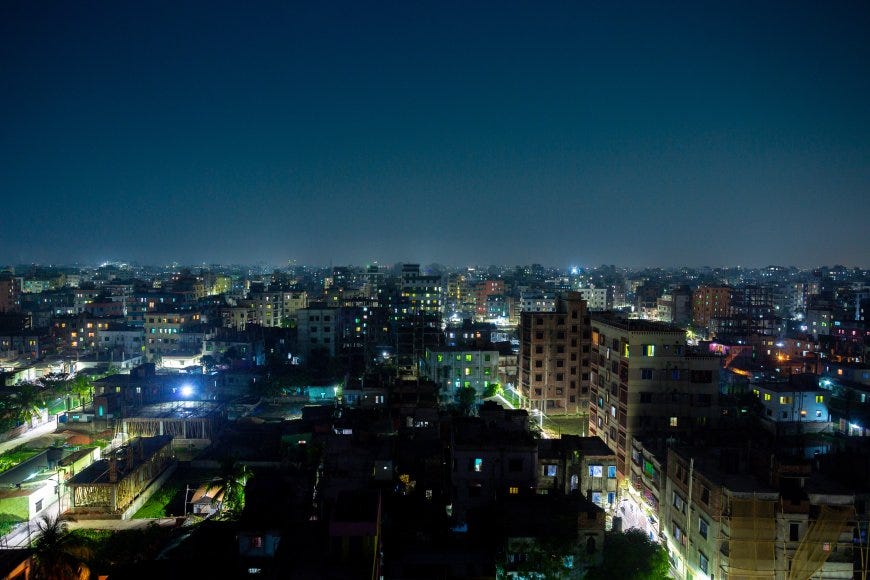
Photo Credit: Shutterstock
Gulshan-2 roundabout, 1:47 AM. The night guard at the empty bank has folded his plastic chair into a temporary bed, his head tilted at an angle that would terrify a chiropractor.
Across the road, three friends huddle around a single phone, sharing its hotspot because the café closed an hour ago and their dorm has no wifi.
The teenager selling roses -- he can’t be more than 14 -- has learned to read couples from fifty paces: The ones who walk too close together will buy; the ones maintaining a careful six inches will not. He is right about nine out of 10.
Do we actually know our nights?
We know the daytime Dhaka -- the gridlock, the grind, the graft. We know which lanes flood in July and which ministers changed portfolios in the latest cabinet shuffle. But after midnight, the city becomes a negative of itself. The streets empty, but something else fills them. The question isn’t what Dhaka does to the soul. It is: Which soul? Whose night?
The Shrinking Hour
In February 2024, The Business Standard ran a feature on 300 Feet -- that aspirational expressway in Purbachal, inaugurated in late 2023 with promises of open space and river views. The headline told a different story: “300 Feet: The late-night haven turns barren amid security concerns”.
A tea-stall owner, whose name the reporter buried in paragraph twelve, described his frustration: forced to close at midnight when the army patrol begins, watching his livelihood evaporate because someone else’s body was found in a lake.
74 people had died on that road in five years -- a BUET student’s motorcycle crushed, a family’s microbus overturned, the TikTokers who filmed themselves racing replaced by patrol cars scanning empty asphaltl.
The irony cuts deep. This expressway was supposed to be Dhaka’s release valve. Now it’s a crime statistic.
Judith Butler would recognise this as the precarity of public space -- who gets to occupy it, who is deemed disposable, whose bodies are allowed to linger under streetlights.
But the night doesn’t announce its rules. It teaches them through absence. You learn which corners are safe by noticing that no one else is there. You learn which hours belong to you by watching who leaves when the patrol arrives.
But where do the displaced go? When a night haunt dies, its people don’t vanish -- they seep elsewhere. The question is: where?